
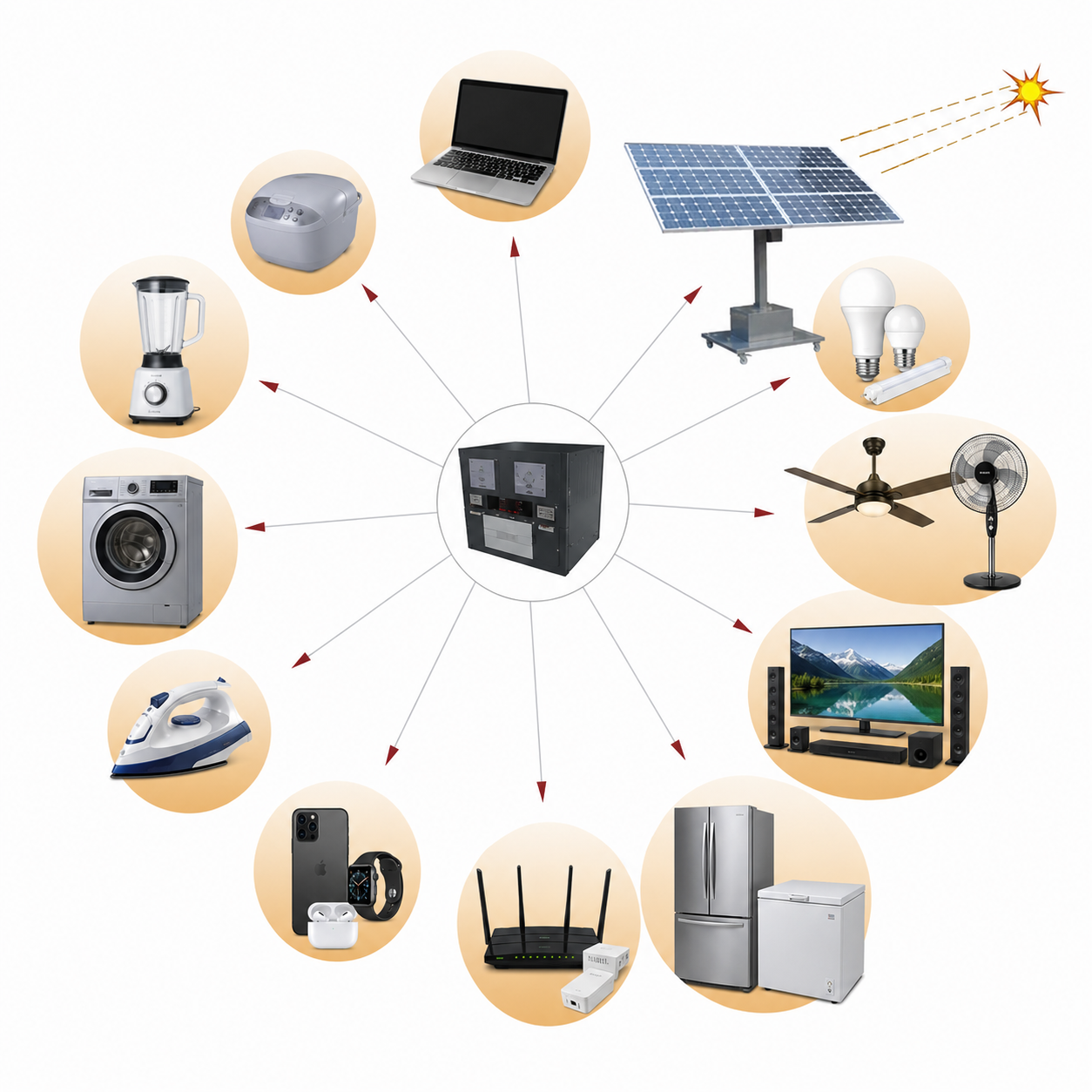
If you are considering solar power for your home in Nigeria, one of the most important questions to ask is: What can a 5kWh solar battery actually power?
With rising electricity costs, frequent grid interruptions, and the high cost of running generators, many Nigerian homeowners are looking for reliable alternatives. A properly designed 5kWh solar battery system can provide backup power for many of the appliances you use every day.
A 5kWh solar battery stores approximately 5,000 watt-hours (Wh) of electrical energy. In theory, that could mean 500 watts of appliances running for about 10 hours, or 1,000 watts running for about 5 hours.
However, real-world performance depends on several factors, including battery chemistry, inverter efficiency, appliance wattage, battery state of charge, and how much solar energy your panels produce.
In this guide, we’ll look at appliances you can power with a 5kWh solar battery, how much energy they typically consume, and how to get the best performance from your solar power system.
What Is a 5kWh Solar Battery?
Before discussing appliances, it is important to understand what the capacity of a 5kWh solar battery means.
The term “5kWh” means the battery has a theoretical storage capacity of approximately 5 kilowatt-hours, or 5,000 watt-hours.
For example:
- A 100W appliance running for 10 hours uses approximately 1,000Wh or 1kWh.
- A 500W appliance running for 5 hours uses approximately 2,500Wh or 2.5kWh.
- A 1,000W appliance running for 5 hours uses approximately 5,000Wh or 5kWh.
In practice, you should not assume that the entire 5kWh capacity will always be available to your appliances. Energy is lost through the inverter and other components, and battery management systems may reserve some capacity to protect the battery.
This is why actual runtime is normally lower than a simple mathematical calculation suggests.
A 5kWh solar battery is often paired with a suitably sized hybrid inverter and solar panels. The solar panels charge the battery during the day, while the stored energy can be used at night or during power outages.
Appliances You Can Power With a 5kWh Solar Battery
1. LED Bulbs and Home Lighting
Lighting is one of the easiest loads to run from a 5kWh solar battery.
Modern LED bulbs are highly energy efficient and can provide plenty of light while consuming relatively little electricity. A typical LED bulb may use between 5W and 15W.
For example, imagine a home with 10 LED bulbs rated at 10W each.
10 × 10W = 100W
If all 10 bulbs were used for eight hours:
100W × 8 hours = 800Wh
That’s only 0.8kWh.
This means a 5kWh solar battery can provide many hours of lighting while leaving substantial energy available for other household appliances.
For homes using solar power, replacing old incandescent or fluorescent bulbs with LEDs is one of the simplest ways to reduce electricity consumption.
2. Ceiling Fans and Standing Fans
Fans are another appliance that works very well with a 5kWh solar battery.
Depending on their size, motor and speed setting, modern fans can consume approximately 40W to 100W, while some older or larger models may consume more.
For example, three 60W fans would have a combined load of:
3 × 60W = 180W
If they operate for eight hours:
180W × 8 hours = 1,440Wh
That’s approximately 1.44kWh.
This means fans can run for several hours without consuming the majority of your battery capacity.
Energy-efficient DC fans can be particularly useful in solar-powered homes because they generally consume less electricity than older AC fans.
If your household relies heavily on fans instead of air conditioning, a 5kWh solar battery can provide substantial overnight backup.
3. Television and Entertainment Systems
Your television is another appliance you can comfortably use with a 5kWh solar battery.
Modern LED and Smart TVs typically consume much less electricity than older plasma televisions. Depending on screen size and model, a TV might consume approximately 50W to 150W.
Let’s assume your Smart TV consumes 100W and operates for six hours:
100W × 6 hours = 600Wh
That’s approximately 0.6kWh.
You can also run other entertainment equipment from your solar battery, including:
- DSTV or GOtv decoder
- Android TV box
- Streaming devices
- Sound systems
- Gaming consoles
The total consumption will depend on the specific equipment you have.
If you want your 5kWh solar battery to last longer, avoid leaving your television and entertainment equipment running when nobody is watching.
4. Refrigerator and Freezer
A refrigerator is one of the most important appliances to consider when designing a home solar system.
Fortunately, a modern energy-efficient refrigerator can be powered by a 5kWh solar battery, provided your inverter is appropriately sized.
Refrigerators operate differently from appliances such as electric irons. Their compressors cycle on and off rather than running continuously throughout the day.
A refrigerator might have a running power requirement of roughly 100W to 300W, but its actual daily energy consumption depends on its size, efficiency, ambient temperature, usage and compressor cycle.
The refrigerator’s startup surge is also important.
When the compressor starts, it can temporarily require significantly more power than its normal running consumption. Your inverter therefore needs to be capable of handling this surge.
For a solar-powered home, an energy-efficient or inverter refrigerator is generally preferable because it can reduce overall energy consumption.
5. Laptop and Computer
Laptops are excellent appliances for solar-powered homes because they typically consume relatively little electricity.
Depending on the model, a laptop charger may be rated around 45W to 100W, although powerful gaming and workstation laptops can consume more.
Suppose your laptop consumes an average of 65W and you use it for eight hours:
65W × 8 hours = 520Wh
That’s approximately 0.52kWh.
This means remote workers, students, freelancers and entrepreneurs can use a 5kWh solar battery to power their computers for several hours while still having energy available for other appliances.
You can also charge:
- Smartphones
- Tablets
- Smartwatches
- Power banks
- Bluetooth headphones
- Cameras
These devices generally have relatively low energy requirements.
6. Wi-Fi Router and Internet Equipment
Internet connectivity has become essential for many households and businesses.
The good news is that routers and modems typically consume very little electricity.
A typical router may consume approximately 5W to 20W.
For example, a 15W router operating continuously for 24 hours would consume:
15W × 24 hours = 360Wh
That’s only 0.36kWh.
Therefore, a 5kWh solar battery can easily support your internet connection alongside other essential household loads.
This can be particularly valuable for people who work from home. During a power outage, your solar system can keep your router, laptop and lighting operational without requiring you to start a generator.
You can also power small networking equipment such as Wi-Fi extenders, network switches and certain CCTV systems.
7. Blender
A blender has a relatively high power rating compared with a television or router, but it is normally used for only a few minutes at a time.
Household blenders can range from approximately 300W to more than 1,000W depending on the model.
Suppose you have a 600W blender and use it for 10 minutes:
600W × 0.167 hours = approximately 100Wh
That’s only about 0.1kWh.
Consequently, occasional blender use does not necessarily place a major burden on a 5kWh solar battery.
However, your inverter must be able to handle the blender’s operating power and startup surge.
This illustrates an important point about solar energy: wattage and energy consumption are not the same thing.
An appliance can have a high wattage but use relatively little total energy if it operates for only a short period.
8. Washing Machine
A washing machine can also be powered by a 5kWh solar battery, but its suitability depends heavily on the model.
Some washing machines consume relatively little electricity, while models that heat water can consume significantly more.
If you are using a solar system, it is generally better to operate energy-intensive appliances during daylight hours.
Why?
Because your solar panels are producing electricity during the day. The panels can power the washing machine directly while simultaneously charging the battery, depending on the system’s configuration and available solar production.
Running the washing machine during strong sunlight can therefore reduce the amount of energy drawn from your battery.
Before connecting a washing machine to your solar system, check its power rating and ensure that your inverter can handle the load.
9. Electric Iron
An electric iron is one of the more demanding household appliances on this list.
Many irons have power ratings between approximately 1,000W and 2,000W.
For example, a 1,500W iron operating continuously for one hour would theoretically consume:
1,500W × 1 hour = 1,500Wh
That’s 1.5kWh.
Therefore, prolonged ironing can consume a substantial amount of energy from a 5kWh solar battery.
The good news is that irons are normally used for relatively short periods.
It is also better to iron during the day when your solar panels are generating electricity. This allows the solar panels to supply much of the power directly rather than relying entirely on stored battery energy.
If you frequently use high-power appliances, consider increasing your solar panel capacity and battery storage.
10. Mobile Phones and Small Electronics
Mobile phones are among the easiest devices to power with a 5kWh solar battery.
A typical smartphone battery may have a capacity of approximately 10Wh to 20Wh, although this varies by device.
Compared with appliances such as refrigerators and electric irons, smartphone charging consumes very little electricity.
Your solar system can also charge:
- Tablets
- Smartwatches
- Power banks
- Rechargeable lamps
- Bluetooth speakers
- Cameras
- Small radios
For households that prioritize essential electricity needs, these small devices can easily be included in the backup load.
How Long Can a 5kWh Solar Battery Last?
One of the most common questions people ask is: How long will a 5kWh solar battery last?
There isn’t one universal answer because battery runtime depends on your total load.
A simple theoretical calculation is:
Battery Capacity ÷ Total Appliance Load = Runtime
For example:
5,000Wh ÷ 500W = 10 hours
In a perfect theoretical situation, a 500W load could run for approximately 10 hours.
READ ALSO: How Much Solar Power Do You Really Need for Your Home in Nigeria?
However, real-world systems experience losses through the inverter, wiring and other components. Battery management settings can also limit the amount of energy that is available.
Therefore, actual runtime will generally be lower.
For example, if your household consumes an average of 500W continuously, you might get roughly 8–9 hours of practical runtime from a fully charged battery, depending on the system.
If your average load is only 250W, the battery could last considerably longer.
Can a 5kWh Solar Battery Power an Air Conditioner?
This is one of the most important considerations when buying a 5kWh solar battery.
An air conditioner can consume significantly more electricity than most of the appliances discussed above.
A small, efficient inverter air conditioner may consume less power than an older conventional unit, but its actual consumption varies according to capacity, temperature settings, room size, insulation, outdoor temperature and operating conditions.
Running an air conditioner for several hours can therefore consume a large percentage of your battery’s stored energy.
If air conditioning is a major requirement in your home, you may need:
- A larger battery bank
- More solar panels
- A larger inverter
- An energy-efficient inverter AC
- Careful load management
A 5kWh battery may be suitable for short periods of air-conditioning use in some systems, but it should not automatically be assumed to provide all-night AC backup.
Appliances You Should Use Carefully With a 5kWh Battery
Although a 5kWh solar battery can handle many household appliances, high-power appliances require careful planning.
These include:
- Air conditioners
- Electric water heaters
- Electric cookers
- Electric ovens
- Electric kettles
- Large water pumps
- Welding machines
- High-power pressing irons
The problem isn’t necessarily that these appliances cannot work with solar power. Rather, they can consume large amounts of energy and may require high instantaneous power.
For example, an electric kettle may operate at 1,500W to 2,500W but only for a few minutes.
An electric water heater, on the other hand, could operate for much longer and therefore consume considerably more energy.
This is why solar system design should consider both power demand (kW) and energy consumption (kWh).
How to Make Your 5kWh Solar Battery Last Longer
Getting the most from your 5kWh solar battery isn’t simply about buying more battery capacity. How you use electricity also matters.
1. Choose Energy-Efficient Appliances
LED lights, efficient refrigerators, DC fans and inverter appliances can reduce your daily energy consumption.
2. Use Heavy Appliances During the Day
Whenever possible, operate washing machines, irons, water pumps and other high-power appliances while your solar panels are producing electricity.
3. Avoid Unnecessary Loads
Turn off lights, televisions, fans and electronics when they aren’t needed.
4. Use an Efficient Inverter
The inverter converts DC electricity from the battery into AC electricity for your appliances. A high-quality, appropriately sized inverter can help reduce conversion losses.
5. Install Enough Solar Panels
A battery must be recharged after it is used.
If your solar panels are too small, the battery may struggle to reach full charge, especially after heavy overnight consumption.
6. Monitor Your Energy Consumption
An energy monitoring system can show how much electricity your household is using. This makes it easier to identify appliances that consume the most energy.
How Many Solar Panels Do You Need for a 5kWh Battery?
The answer depends on your location, sunlight availability, panel wattage, system losses and how quickly you want the battery recharged.
For example, a system using 600W solar panels could have:
4 × 600W = 2,400W or 2.4kW of solar panel capacity
A larger array could recharge the battery faster and provide more daytime power for appliances.
However, solar panel sizing should not be based solely on battery capacity.
Your installer should consider your:
- Daily energy consumption
- Peak load
- Desired backup duration
- Available sunlight
- Battery specifications
- Inverter capacity
For a Nigerian home, proper system sizing is particularly important because solar production varies with weather, season and installation conditions.
Is a 5kWh Solar Battery Enough for a Nigerian Home?
For many small and medium households, a 5kWh solar battery can be an excellent starting point for essential backup power.
It can provide electricity for everyday loads such as:
- Lights
- Fans
- Television
- Refrigerator
- Internet router
- Laptop
- Mobile phones
- Small kitchen appliances
However, every household has different electricity requirements.
A family that uses several air conditioners, electric cooking appliances, water heaters and other high-power devices may need a larger solar battery system.
The best approach is to calculate your household’s energy consumption before purchasing a system.
5kWh Solar Battery vs Generator
For many Nigerian households, the biggest advantage of a 5kWh solar battery is that it can provide quiet and clean backup power without the fuel costs and noise associated with a petrol or diesel generator.
A solar battery system also requires less routine interaction once properly installed.
A generator requires fuel and regular maintenance, while a solar system primarily requires proper installation, battery management and periodic maintenance.
Solar power can therefore be particularly attractive for households that experience frequent outages or want to reduce generator dependence.
However, the initial cost of installing a solar system can be higher than purchasing a small generator. The long-term value depends on how much electricity you consume and how frequently you would otherwise rely on a generator.
Final Thoughts
A 5kWh solar battery can power far more than just a few lights. When combined with the right inverter, sufficient solar panels and energy-efficient appliances, it can provide reliable backup electricity for many essential household needs.
The 10 appliances and devices discussed in this guide include:
- LED bulbs and lighting
- Ceiling and standing fans
- Television and entertainment systems
- Refrigerator and freezer
- Laptop and computer
- Wi-Fi router and internet equipment
- Blender
- Washing machine
- Electric iron
- Mobile phones and small electronics
The key is understanding your electricity consumption.
A 5kWh solar battery is not automatically suitable for every household. Your ideal battery capacity depends on how much electricity you use, which appliances you operate, how long you need backup power, and how much solar energy your panels can generate.
If your goal is to power essential appliances such as lights, fans, a refrigerator, TV, internet equipment and computers, a 5kWh system can be a practical solution.
If you want to run multiple air conditioners, electric cookers, water heaters or other heavy loads, you may need a larger battery and inverter system.
Before purchasing a solar system, have your electricity requirements properly assessed. Correct sizing can help you avoid spending money on a system that is either too small for your needs or unnecessarily large.
Ofasa Energy Solutions provides solar and renewable energy solutions designed around your actual electricity requirements. Whether you need a 5kWh battery system for essential home appliances or a larger solar installation for your home or business, proper system design is the foundation of reliable solar power.
Ready to find out what solar system your home needs? Contact Ofasa Energy Solutions for a personalized solar assessment and solution tailored to your electricity consumption.
Leave a Reply